

The Ultimate Guide to Ecommerce Artificial Intelligence
The Ultimate Guide to Ecommerce
Artificial Intelligence
Short on time? We'll email you the guide to read later.
Introduction
Artificial Intelligence has made significant strides in different sectors with ecommerce being no exception. This comprehensive guide offers an in-depth exploration of Ecommerce Artificial Intelligence, its many benefits, use cases, considerations for implementation, and the future of AI in ecommerce.
AI in ecommerce refers to the ways to use AI in ecommerce to optimize and personalize the online shopping experience for customers. It’s a powerful mechanism capable of transforming the ecommerce experience from a simple online shopping platform into a highly personalized, interactive, and efficient digital marketplace.
This guide will help you:
- Understand how the implementation of AI can be an absolute game-changer for online businesses.
- Gain an edge over other retailers by providing a more personalized and efficient shopping experience for your customers.
Welcome to the revolution of AI!
Table of Contents
01
What is Ecommerce Artificial Intelligence and Why is it Important
02
Benefits of Ecommerce Artificial Intelligence
03
Use Cases of Ecommerce Artificial Intelligence
04
Key Considerations When Implementing Ecommerce Artificial Intelligence
05
Optimizing Operations with Artificial Intelligence Tools and Platforms
06
Boosting Sales with Artificial Intelligence
07
The Role of AI in the Future of Ecommerce
What is Ecommerce Artificial Intelligence and Why is it Important
Ecommerce Artificial Intelligence analyzes customer behavior to better understand your shoppers to provide a personalized experience on your website. It collects insights on your browsing behavior and then uses complex algorithms to analyze patterns for actionable insights. Proto AI is setting a new standard in delivering highly personalized customer experiences in ecommerce, by relying on real-time behavior, rather than training data, to make predictions. Proto AI makes it possible to understand what will happen in the future without the need to “train” or collect large datasets — instead, Proto AI looks at individual behavior patterns to deliver custom recommendations.
Online shopping has gotten smarter with AI. It’s like having a personal shopping assistant that knows your every move. How does it work? By analyzing your browsing behavior, ecommerce AI can predict what you want and offer personalized recommendations in real-time. With the increasing volume of online transactions, businesses need efficient ways to process information while providing exceptional service. Ecommerce AI enables personalization, automation, data-driven decisions, cutting-edge customer experiences, and fraud detection. By leveraging innovative technologies effectively, businesses can stay ahead competitively and reap the benefits of AI in ecommerce.
Benefits of Ecommerce Artificial Intelligence
Ever feel like your online shopping experience is eerily accurate? That’s not just good luck. It’s AI, making waves and creating a seamless user experience in ecommerce from start to finish – creating personalized product recommendations, optimizing operations, and even detecting fraud. AI is no longer a sci-fi dream, but an everyday reality that’s making waves across industries. And the realm where it’s making its presence felt most? Ecommerce. Predictions suggest that by 2025, we’ll see a whopping $5.94 billion invested globally into AI for eCommerce alone.
So why this frenzy around AI?
Personalization
AI allows ecommerce businesses to provide personalized product recommendations based on a customer’s behavior and preferences.
Automation
AI can automate various tasks such as inventory management, customer service, and data analysis, saving businesses time and resources.
Enhanced Customer Service
AI-powered chatbots and virtual assistants can provide instant customer support, answering queries and resolving issues 24/7.
Data Analysis and Insights
AI can analyze vast amounts of customer data to provide valuable insights, helping businesses make informed decisions and improve their strategies.
Fraud Detection
AI can help ecommerce businesses prevent and detect fraudulent transactions, protecting both the business and its customers.
Use Cases of Ecommerce Artificial Intelligence
Gone are the days of one-size-fits-all shopping; consumers now crave tailored experiences that make them feel special. Enter personalized product recommendations powered by sophisticated algorithms – the new best friends of consumers who love tailored experiences.
No more sifting through endless pages of products you don’t care about. Instead, these AI solutions show exactly what interests you based on past behavior patterns. The result? A hefty increase in conversion rates by up to 85%, thanks again to our silent hero: AI. The adoption of artificial intelligence in ecommerce has revolutionized the way businesses operate. From personalized product recommendations to advanced customer service, AI has proven its worth time and again.
Real-world examples where companies have successfully integrated AI into their ecommerce platforms:
Predictive Analytics for Personalization
Major retailers like Amazon and Netflix use predictive analytics powered by AI to provide personalized recommendations. These systems analyze user behavior data, to suggest products or content that align with the customer’s preferences. This level of personalization enhances the shopping experience and increases sales conversions.
Chatbots Improving Customer Service
Customers expect instant responses, and chatbots play a crucial role in enhancing customer service. For instance, Staples has integrated IBM Watson’s AI technology into its mobile app. The “Easy System” uses machine learning algorithms to understand natural language queries from customers and respond accordingly. This system allows Staples to handle large volumes of inquiries efficiently while providing personalized assistance around the clock.
Personalized Product Recommendations
Digging deeper into this trend, it becomes clear that one major way in which AI contributes to personalization is through product recommendations. Imagine you’re browsing an online store for a new pair of running shoes and the site suggests some high-performance socks or even your favorite energy drink? That’s AI at work. We’ve seen firsthand how effective this can be, especially when backed up by real-time user behavior data rather than just past purchases or searches. We found out that such personalized suggestions made using our algorithms can increase average order value by up to 17%.
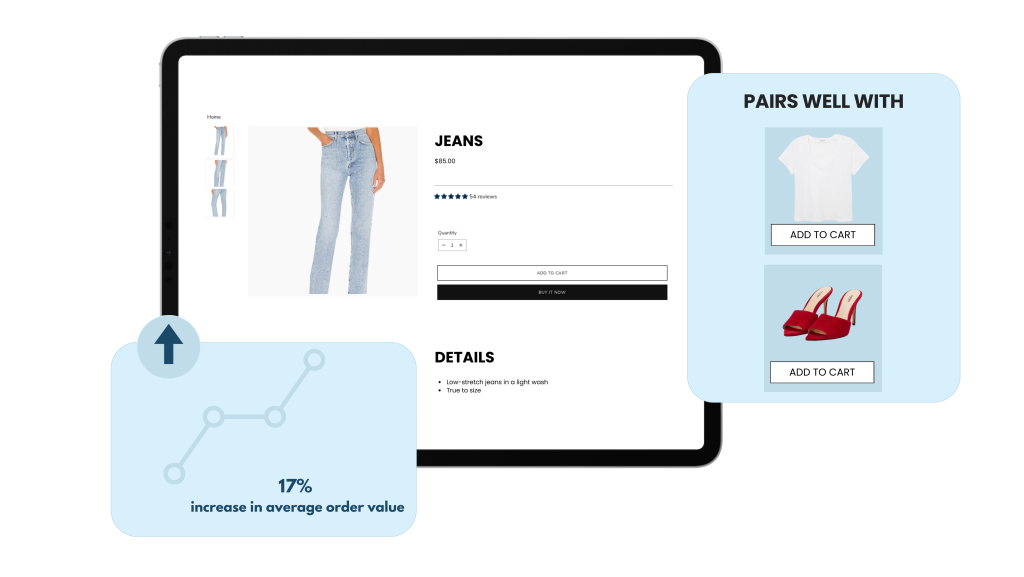
Increase in Sales with Virtual Assistants
Beyond suggesting products, AI also helps customers find exactly what they are looking for, think virtual assistants like Siri or Alexa on steroids. This isn’t about asking them about the weather anymore; it’s more like “Hey assistant, show me black formal dresses under $100 available in size M”.
This level of help results not only in happier customers and less cart abandonment — as much as 40% lower according to our experience. It’s all about making customer journeys smoother and businesses healthier. Businesses can leverage ecommerce AI technologies like Proto AI, which relies on real-time user behavior for decision-making processes.
— Article Continues Below —
Key Considerations When Implementing Ecommerce Artificial Intelligence
Cost versus Benefit Analysis: Before starting an AI integration, make sure it’s worth the investment. Consider the potential gains versus the financial and time investment required, including ongoing expenses.
Data Privacy and Security: Protecting customer data is crucial. Ensure that your AI platform adheres to regulations like GDPR and has robust data protection measures in place.
Choosing the Right Technology: Implementing the right AI tools and technologies is key to a successful transition. Selecting the proper AI tools and technologies for your project is vital — there are numerous potential solutions, so ensure that you pick ones that match your goals and requirements.
Optimizing User Experience: Always keep user experience in mind when incorporating AI elements into your ecommerce platform. Whether it’s smart search features or intelligent chatbots, the goal should be to enhance the overall shopping journey for users and increase sales conversions.
Optimizing Operations with Artificial Intelligence Tools and Platforms
A significant way AI improves efficiency in ecommerce lies in automation. With routine tasks such as inventory management, product recommendations, order processing, and customer support being taken over, companies can focus more on strategic decisions and less on manual work. Traditionally labor-intensive processes prone to human error, now become seamless thanks to AI systems that analyze data patterns for accurate predictions.
Beyond inventory control and order handling processes though, perhaps one of the most noticeable changes brought about is how AI is changing the way ecommerce sites make product recommendations. To give each shopper what they need when they need it, businesses must understand their audience on a granular level – as individuals. By tracking real-time user activity data, such as browsing behavior, AI can develop highly personalized experiences and show customized content based on the specific customer.
Customer support is another key area where AI shines, the use of chatbots to handle basic inquiries efficiently without needing any human intervention – reducing response time drastically while freeing up staff resources for complex queries requiring personal attention.
Studies suggest that the efficient use of AI in ecommerce can lead to significant cost savings and improved operational efficiency.
Businesses are looking to adapt their customer engagement strategies to keep up with the changes in consumer behavior. In this era, engaging customers isn’t just about having a great product or service; it’s also about understanding customer behavior and preferences. True success lies beyond one-time purchases — it’s all about building long-term relationships. This hyper-personalization doesn’t stop at product recommendations, it extends into email campaigns and rewards programs. For instance, if a customer frequently purchases athletic wear, they might receive special campaigns or early access to new sports gear. This personalized touch fosters brand loyalty.
The Role of AI in the Future of Ecommerce
As technology continues to advance, we can expect to see AI playing an even bigger role in ecommerce. However, as with any technology, there are challenges and risks associated with the use of AI in ecommerce, including data security concerns, accuracy errors, and the capital investment required to implement AI.
These AI systems in ecommerce analyze behavior from the customers on your site. This data aids in creating on-the-spot recommendations that align with shifting consumer behaviors, trends and statistics; a a powerful tool for staying relevant and responsive within ecommerce.
We’ve learned about personalized shopping experiences that feel uncannily spot-on, thanks to AI. And let’s not forget how operations are getting an efficiency boost with automated tasks and data-driven decisions. All these leading to higher sales and increased loyalty. If you are in retail, AI is the next step for your ecommerce venture.